- +971561663345
- file@dubaiadvocates.ae
- Mon-Fri 9:00 am - 7:00 pm

Navigating Amicable Dispute Resolution
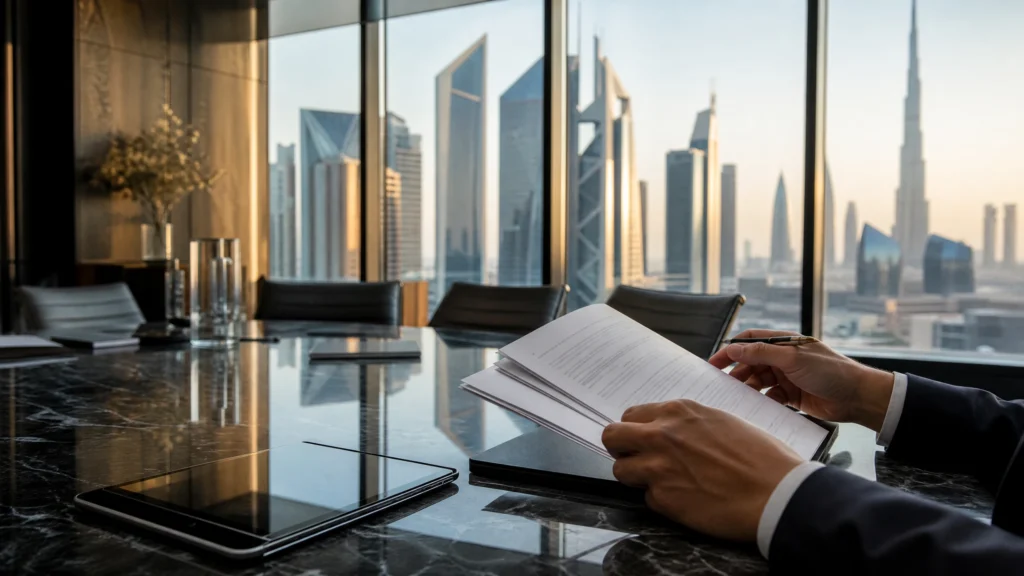
In the rapidly evolving commercial landscape of the United Arab Emirates, disputes are often an inevitable byproduct of progress. However, the traditional path of litigation is no longer the only—or even the preferred—route for sophisticated entities and individuals. Under the strategic guidance of Adv. Ibrahim Khaleel, DubaiAdvocates.ae has consistently championed the shift toward Mediation Services, a voluntary and confidential process that empowers parties to resolve conflicts with speed, privacy, and commercial pragmatism.
The UAE has undergone a legislative revolution in recent years, formalizing alternative dispute resolution (ADR) to align with international standards. Whether dealing with complex corporate disagreements, real estate friction, or family matters, mediation offers a structured environment where a neutral third party facilitates a mutually acceptable settlement. This guide explores the legal framework, the nuances of different jurisdictions such as the DIFC and ADGM, and the vital role of specialized legal counsel in securing enforceable outcomes.
The Legal Pillars of Mediation in the UAE
The foundation of mediation in the Emirates is built upon robust federal and local legislation designed to ensure that settlements are not just “gentlemen’s agreements” but legally binding mandates.
Federal Decree-Law No. 40 of 2023
The most significant development in recent years is the Federal Decree-Law No. 40 of 2023 on Mediation and Conciliation in Civil and Commercial Disputes. This law superseded the previous 2021 legislation, providing a more comprehensive framework for both “Judicial Mediation” (referred by a court) and “Non-Judicial Mediation” (initiated by parties independently).
Under this law, a mediation agreement must be in writing and clearly define the subject of the dispute. Crucially, it establishes that any settlement reached and signed by the parties—and subsequently approved by the competent judge—carries the legal weight of an executory deed. This means it can be enforced directly through the execution courts, bypassing the need for a full trial.
Dubai Law No. 18 of 2021
In the Emirate of Dubai, Law No. 18 of 2021 regulates the conciliation and mediation activities specifically within the local judicial system. This law empowers the Centre for Amicable Settlement of Disputes (CASD), an arm of the Dubai Courts, to handle specific types of claims before they can even be heard by a judge. This “mandatory mediation” phase for certain civil and commercial disputes is a hallmark of Dubai’s commitment to reducing the burden on the judiciary and fostering a business-friendly environment.
Jurisdiction Matters: Onshore vs. Offshore Mediation
One of the unique aspects of the UAE legal system is the existence of multiple jurisdictions. At DubaiAdvocates.ae, we assist clients in navigating the specific procedural requirements of each forum.
Dubai Courts and the CASD
For disputes falling under the jurisdiction of the Dubai Courts, the Centre for Amicable Settlement of Disputes plays a pivotal role. The process is typically conducted in Arabic, though translators are permitted. The objective here is to reach a settlement agreement within a statutory timeframe (usually 15 to 30 days, extendable by the judge). If successful, the agreement is signed, authenticated, and becomes an enforceable title.
DIFC Courts (Dubai International Financial Centre)
The DIFC Courts operate under a common law framework and emphasize mediation through the DIFC Mediation Service Centre. According to the Rules of the DIFC Courts (RDC) Part 27, the court has the power to encourage parties to use ADR if it considers it appropriate. Mediation in the DIFC is highly favored for international commercial contracts, offering a process conducted in English and handled by internationally accredited mediators.
ADGM (Abu Dhabi Global Market)
The ADGM Courts and their dedicated Arbitration and Mediation Centre provide a state-of-the-art platform for dispute resolution. Similar to the DIFC, the ADGM framework is rooted in English Common Law. Recent initiatives, such as the “UAE Mediation First Pledge” (2026), highlight ADGM’s push for businesses to choose mediation as a primary step before escalating to litigation.
Key Scenarios: When is Mediation Most Effective?
While mediation is versatile, certain scenarios benefit significantly from this confidential approach. Adv. Ibrahim Khaleel and the team at DubaiAdvocates.ae often recommend mediation in the following contexts:
1. Real Estate and Construction Disputes
In Dubai’s dynamic real estate market, disputes often arise regarding payment milestones, delays, or property specifications. Referring these to the Dubai Land Department (DLD) or the CASD can save developers and investors years of litigation.
2. Corporate and Shareholder Disagreements
Maintaining business relationships is critical. Mediation allows shareholders to resolve “deadlock” situations or profit-sharing disputes without the public exposure that comes with a court filing, thereby protecting the company’s reputation and share value.
3. Employment and Labor Issues
Under the Ministry of Human Resources and Emiratisation (MOHRE), many labor disputes must undergo a mandatory conciliation phase. This ensures that employees and employers have a chance to settle claims regarding end-of-service benefits or arbitrary dismissal amicably.
The Role of the Mediator: Neutrality and Confidentiality
A common question from clients is: “Can the mediator pick a side?” The answer, under Federal Decree-Law No. 40 of 2023, is a strict no.
- Impartiality: The mediator cannot have a personal interest in the dispute or a relationship with any party up to the fourth degree of kinship.
- Confidentiality: This is the cornerstone of the process. Anything said or any document produced during mediation is privileged. It cannot be used as evidence in court if the mediation fails.
- Voluntary Nature: Except in cases of mandatory court-ordered referral, parties are free to enter and exit the process at their discretion.
The Role of DubaiAdvocates.ae Lawyers and Legal Consultants
Navigating mediation requires more than just a willingness to talk; it requires a strategic legal mind to ensure that your rights are protected and that the final settlement is waterproof.
Under the leadership of Adv. Ibrahim Khaleel, our firm provides end-to-end support in mediation:
- Drafting Mediation Clauses: We ensure your commercial contracts include robust ADR clauses that specify the venue, language, and governing rules.
- Case Preparation: We compile the necessary evidence and legal arguments to present a strong position during the sessions.
- Representation: While mediation is less formal than a trial, having a seasoned legal consultant ensures that the opposing party does not exert undue pressure and that the settlement terms are equitable.
- Enforcement: Once a settlement is reached, we handle the formalities of having it endorsed by the Dubai Courts, DIFC, or ADGM to ensure it is immediately enforceable.
Overview
English
Mediation in the UAE is a confidential, voluntary process governed primarily by Federal Decree-Law No. 40 of 2023. It allows parties to settle civil and commercial disputes through a neutral third party. Settlements reached are legally binding and enforceable as court judgments once ratified. This method is faster and more cost-effective than traditional litigation.
Arabic (العربية)
الوساطة في دولة الإمارات هي عملية تطوعية وسرية تحكمها بشكل أساسي المرسوم بقانون اتحادي رقم 40 لسنة 2023. تتيح للأطراف تسوية النزاعات المدنية والتجارية من خلال طرف ثالث محايد. تعتبر اتفاقيات التسوية التي يتم التوصل إليها ملزمة قانوناً وقابلة للتنفيذ كأحكام قضائية بمجرد تصديقها. وتعد هذه الوسيلة أسرع وأكثر فعالية من حيث التكلفة مقارنة بالتقاضي التقليدي.
French (Français)
La médiation aux Émirats Arabes Unis est un processus confidentiel et volontaire régi principalement par le décret-loi fédéral n° 40 de 2023. Elle permet aux parties de régler des litiges civils et commerciaux par l’intermédiaire d’un tiers neutre. Les accords conclus sont juridiquement contraignants et exécutoires comme des jugements une fois ratifiés.
Russian (Русский)
Медиация в ОАЭ — это конфиденциальный и добровольный процесс, регулируемый Федеральным декретом-законом № 40 от 2023 года. Она позволяет сторонам разрешать гражданские и коммерческие споры через нейтральное третье лицо. Достигнутые мировые соглашения имеют юридическую силу и подлежат принудительному исполнению как судебные решения после их утверждения.
Chinese (中文)
阿联酋的调解是一项保密且自愿的过程,主要受2023年第40号联邦法令准则管辖。它允许各方通过中立的第三方解决民事和商业纠纷。一旦获得批准,达成的和解协议具有法律约束力,并可作为法院判决强制执行。
Italian (Italiano)
La mediazione negli Emirati Arabi Uniti è un processo riservato e volontario, disciplinato principalmente dal Decreto Legge Federale n. 40 del 2023. Consente alle parti di risolvere controversie civili e commerciali tramite un terzo neutrale. Gli accordi raggiunti sono legalmente vincolanti ed esecutivi come sentenze giudiziarie una volta ratificati.
Spanish (Español)
La mediación en los EAU es un proceso confidencial y voluntario regido principalmente por el Decreto-Ley Federal n.º 40 de 2023. Permite a las partes resolver disputas civiles y comerciales a través de un tercero neutral. Los acuerdos alcanzados son legalmente vinculantes y ejecutables como sentencias judiciales una vez ratificados.
German (Deutsch)
Die Mediation in den VAE ist ein vertrauliches und freiwilliges Verfahren, das hauptsächlich durch das Bundesdekret-Gesetz Nr. 40 von 2023 geregelt wird. Es ermöglicht den Parteien, zivil- und handelsrechtliche Streitigkeiten durch einen neutralen Dritten beizulegen. Die erzielten Vergleiche sind rechtsverbindlich und nach ihrer Ratifizierung wie Gerichtsurteile vollstreckbar.
Hebrew (עברית)
גישור באיחוד האמירויות הוא תהליך חסוי ומרצון המוסדר בעיקר על ידי צו-חוק פדרלי מס’ 40 משנת 2023. הוא מאפשר לצדדים ליישב סכסוכים אזרחיים ומסחריים באמצעות צד שלישי ניטרלי. הסכמי פשרה שהושגו הם מחייבים מבחינה משפטית וניתנים לאכיפה כפסקי דין לאחר אישורם.
Turkish (Türkçe)
BAE’de arabuluculuk, temel olarak 2023 tarihli ve 40 sayılı Federal Kanun Hükmünde Kararname ile düzenlenen gizli ve gönüllü bir süreçtir. Tarafların sivil ve ticari uyuşmazlıkları tarafsız bir üçüncü kişi aracılığıyla çözmelerine olanak tanır. Varılan anlaşmalar onaylandıktan sonra mahkeme ilamı gibi yasal olarak bağlayıcı ve icra edilebilirdir.
Afrikaans
Mediasie in die VAE is ‘n vertroulike, vrywillige proses wat hoofsaaklik gereguleer word deur Federale Dekreet-Wet No. 40 van 2023. Dit stel partye in staat om siviele en kommersiële gespille deur ‘n neutrale derde party op te los. Skikkings wat bereik word, is wetlik bindend en afdwingbaar as hofuitsprake sodra dit bekragtig is.
Filipino (Tagalog)
Ang mediation sa UAE ay isang kumpidensyal at boluntaryong proseso na pinamamahalaan ng Federal Decree-Law No. 40 ng 2023. Pinapayagan nito ang mga panig na ayusin ang mga sibil at komersyal na hidwaan sa pamamagitan ng isang neutral na ikatlong panig. Ang mga kasunduang narating ay legal na may bisa at maaaring ipatupad tulad ng desisyon ng korte kapag naratify na.
Frequently Asked Question
Is mediation mandatory in Dubai?
For certain cases, yes. Under Law No. 18 of 2021, specific civil and commercial disputes must first go to the Centre for Amicable Settlement of Disputes (CASD).
Can I use an English-speaking mediator in Dubai?
While the official language of onshore courts is Arabic, the DIFC and ADGM provide mediation services entirely in English.
How long does a mediation session take?
A single session usually lasts a few hours, but the entire process typically concludes within 15 to 30 days.
What happens if we reach a settlement?
The agreement is written, signed, and submitted to a judge for approval, becoming an enforceable “writ of execution.”
What if mediation fails?
If no agreement is reached, the mediator issues a “non-settlement” certificate, allowing the parties to proceed to litigation.
Are the discussions confidential?
Yes, Article 15 of Federal Decree-Law No. 40 of 2023 strictly prohibits disclosing mediation discussions in court.
Can a mediator be called as a witness?
No, mediators are generally prohibited from testifying about the mediation process in future litigation.
Does a mediation agreement expire?
Once ratified by the court, it has the same permanence as a final judicial judgment.
Who pays for the mediation?
Typically, costs are shared equally unless the parties agree otherwise in the mediation agreement.
Can I mediate a family dispute?
Yes, family disputes are often referred to the Family Guidance and Reconciliation Committee at the Dubai Courts.
Is mediation legally binding?
Only once the settlement agreement is signed by both parties and approved by the competent judicial authority.
Can I bring my lawyer to mediation?
Absolutely. Legal representation is highly recommended to ensure your interests are protected during negotiations.
Is mediation cheaper than court?
Yes, because it avoids lengthy trial procedures, expert fees, and extensive court hearings.
What is the difference between mediation and arbitration?
In mediation, the parties decide the outcome; in arbitration, the arbitrator makes a binding decision for the parties.
Can international companies use UAE mediation?
Yes, especially through the DIFC or ADGM, which are designed for international commercial disputes.
Sum-up
Mediation Services in the UAE represent a sophisticated, efficient, and cost-effective alternative to traditional litigation. With the introduction of Federal Decree-Law No. 40 of 2023 and the localized expertise of the Dubai Courts’ CASD, parties now have a reliable framework to resolve disputes while maintaining confidentiality and commercial relationships. At DubaiAdvocates.ae, our mission is to guide you through this process with the authority and strategic insight that Adv. Ibrahim Khaleel is known for, turning conflict into resolved, enforceable outcomes.
Call to Action (CTA):
Email: file@dubaiadvocates.ae Phone/WhatsApp: +971561663345 Website: https://dubaiadvocates.ae/
Disclaimer:
“This content is for general informational purposes only and does not constitute legal advice. For advice specific to your situation, consult a qualified legal professional in the UAE.”
Category
Get in touch
contact us
Send us a email
file@dubaiadvocates.ae
Contact with us
Our office location
Le Solarium Tower, Level 13, Office 13, Dubai Silicon Oasis, Dubai.
A licensed UAE law firm advising individuals and businesses across corporate law, criminal defence, real estate, employment, family law, and commercial disputes — throughout UAE onshore courts, DIFC, and ADGM.
pages
Working hour
- Monday - Friday
- 09:00 am - 07:00 pm