- +971561663345
- file@dubaiadvocates.ae
- Mon-Fri 9:00 am - 7:00 pm

Navigating Construction Law in the UAE
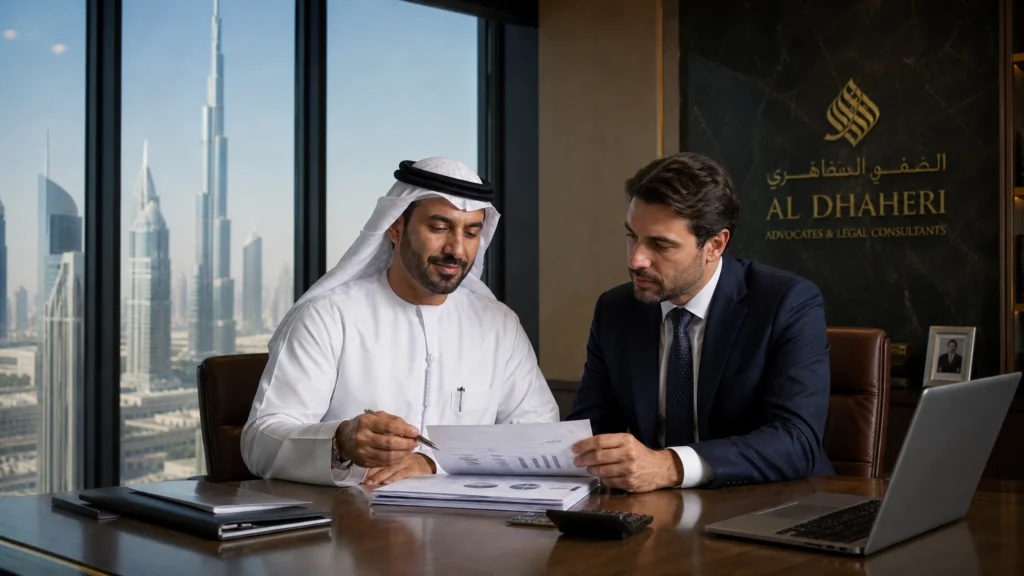
The United Arab Emirates has long been a global benchmark for ambitious infrastructure and architectural marvels. From the soaring heights of the Burj Khalifa to the strategic expansion of Etihad Rail, the nation’s skyline is a testament to its dynamic building sector. However, behind every crane and concrete pour lies a complex web of legalities. Construction law in the UAE is a specialized field that governs the relationships between employers (owners), contractors, subcontractors, and consultants.
At DubaiAdvocates.ae, led by the strategic vision of Adv. Ibrahim Khaleel, we recognize that the success of a project depends as much on legal structural integrity as it does on engineering. As the UAE transitions into a new era of legislative modernization—marked by the introduction of the new Civil Transactions Law and specialized Emirate-level decrees—staying ahead of compliance requirements is paramount for developers and contractors alike. This guide explores the essential frameworks, from the traditional Muqawala contract to the intricacies of decennial liability.
The Legal Foundation: Muqawala and the UAE Civil Code
The bedrock of construction legalities in the UAE is found within the Federal Decree-Law No. 42 of 2022 on Civil Transactions (which superseded the long-standing Federal Law No. 5 of 1985). Within this code, construction is categorized under a Muqawala contract—a contract whereby one party undertakes to make a thing or perform a task in consideration of a price which the other party undertakes to pay.
Under the UAE Civil Code, specifically Articles 872 through 896, the rights and obligations of parties are clearly defined. Unlike common law jurisdictions where the contract is the “be-all and end-all,” the UAE’s civil law system provides mandatory provisions that can override contractual terms, particularly concerning public policy and “good faith” (Article 246).
Essential Obligations under the Civil Code:
- Performance and Quality: The contractor must perform the work in accordance with the agreed specifications and within the timeframe.
- Provision of Materials: Unless otherwise agreed, the contractor is generally responsible for providing the tools and materials necessary for the completion of the work.
- Liability for Defects: The contractor remains liable for any defects in the work that appear after delivery, subject to the statutory limitation periods.
Decennial Liability: The Ten-Year Safety Net
One of the most distinct features of UAE construction law is the concept of Decennial Liability, governed by Article 880 of the Civil Code. This is a form of strict liability imposed on both the contractor and the supervising architect or engineer.
Legal Reference: Article 880 (1) states that the contractor and architect are jointly liable for a period of ten years from the date of delivery of the work if the building suffers total or partial collapse, or if a defect is discovered which threatens the stability or safety of the edifice.
This liability is mandatory. Any contractual clause attempting to exempt or limit this ten-year liability is considered null and void under Article 882. It is important to note that this liability applies even if the collapse or defect arises from the nature of the land itself or if the employer consented to the construction of the defective buildings.
Landmark Update: Dubai Law No. 7 of 2025
A significant shift in the regulatory landscape occurred with the enactment of Dubai Law No. 7 of 2025 Regulating Contractors’ Activities in the Emirate of Dubai. Effective from January 2026, this law centralizes the regulation of all contracting activities within the Emirate, including free zones like the DIFC.
Key Provisions of Law No. 7 of 2025:
- Unified Register: The creation of an Emirate-wide Contractors’ Register managed by the Dubai Municipality (DM).
- Professional Competency Certificates (PCC): Engineers and technical staff must now obtain a PCC to operate legally on sites.
- Tiered Classification: Contractors are classified into specific tiers based on their technical capacity, financial standing, and past performance.
- Mandatory Records: Contractors must maintain project records, plans, and contracts for a minimum of ten years.
This law aims to enhance transparency and ensure that only qualified entities handle the high-stakes projects that define Dubai’s real estate market.
Dispute Resolution: Dubai Courts vs. Arbitration
When disputes arise—whether regarding payment delays, variations, or site conditions—parties in the UAE have several forums for resolution.
1. Dubai Courts (Mainland)
The Dubai Courts operate on a civil law basis, where proceedings are conducted in Arabic. In construction matters, the court often appoints an independent expert (typically an engineer) to evaluate technical claims and provide a report which the judge heavily relies upon.
2. DIFC and ADGM Courts
The Dubai International Financial Centre (DIFC) Courts and Abu Dhabi Global Market (ADGM) Courts operate under an English-language, common law system. They are increasingly favored for complex international construction disputes due to their specialized Technology and Construction Divisions.
3. Arbitration and DIAC
Given the technical nature of construction, arbitration is the preferred route for many. Federal Law No. 6 of 2018 on Arbitration provides a modern framework for these proceedings. The Dubai International Arbitration Centre (DIAC) is the leading institution for resolving such matters, offering a neutral ground and specialized arbitrators.
Relevant Authorities and Regulatory Bodies
Navigating a project requires interaction with various government entities that ensure safety, quality, and legal compliance:
- Dubai Land Department (DLD): Oversees the registration of real estate and development projects.
- Real Estate Regulatory Agency (RERA): Regulates the relationship between developers and investors.
- Dubai Municipality (DM): The primary body for building permits, site inspections, and contractor licensing under the new 2025 law.
- Ministry of Energy and Infrastructure: Manages federal-level infrastructure projects and national building codes.
- Abu Dhabi Department of Municipalities and Transport (DMT): Regulates construction and urban planning within the capital.
Key Scenarios: Managing Variations and Delays
Variations and Change Orders
In the UAE, variations are a frequent source of conflict. Under the Civil Code, if a “lump sum” price is agreed upon, the contractor cannot generally demand an increase in price due to a rise in material costs or labor. However, if the design changes or additional work is requested by the employer, the contractor is entitled to fair compensation for that extra work.
Liquidated Damages vs. Actual Loss
Many contracts include “Liquidated Damages” for delays. However, Article 390 of the Civil Code allows a UAE judge or arbitrator to adjust these damages—either increasing or decreasing them—to match the actual loss suffered by the aggrieved party. This is a critical distinction from many Western jurisdictions where liquidated damages are often fixed.
The Role of DubaiAdvocates.ae Lawyers and Legal Consultants
Construction projects are high-value, high-risk endeavors. The team at DubaiAdvocates.ae, under the expert guidance of Adv. Ibrahim Khaleel, provides comprehensive legal support to safeguard your interests from ground-breaking to handover.
Our services include:
- Contract Drafting and Review: Customizing FIDIC forms or bespoke agreements to align with UAE mandatory laws.
- Regulatory Compliance: Assisting contractors with the new registration requirements of Dubai Law No. 7 of 2025.
- Dispute Management: Representing clients in DIAC arbitration, DIFC Courts, and UAE Federal Courts.
- Decennial Liability Defense: Advising on risk mitigation and insurance requirements for structural liability.
With over 15 years of local experience, Adv. Ibrahim Khaleel ensures that your legal foundation is as solid as your physical one.
Overview
English:
Construction law in the UAE is governed by the Civil Transactions Law and specific Emirate-level decrees. Key concepts include the Muqawala contract and mandatory decennial liability, which holds contractors liable for structural defects for ten years. Recent updates, such as Dubai Law No. 7 of 2025, introduce a unified register for contractors. Dispute resolution typically occurs through Dubai Courts, DIFC/ADGM Courts, or arbitration via DIAC.
Arabic (العربية):
تخضع قوانين البناء في دولة الإمارات العربية المتحدة لقانون المعاملات المدنية والمراسيم المحلية. تشمل المفاهيم الأساسية “عقد المقاولة” والمسؤولية العشرية الإلزامية، التي تُحمل المقاولين والمهندسين مسؤولية العيوب الإنشائية لمدة عشر سنوات. تقدم التحديثات الأخيرة، مثل قانون دبي رقم 7 لعام 2025، سجلاً موحداً للمقاولين. يتم حل النزاعات عادةً عبر محاكم دبي، أو محاكم مركز دبي المالي العالمي، أو التحكيم عبر مركز دبي للتحكيم الدولي.
French (Français):
Le droit de la construction aux Émirats Arabes Unis est régi par la loi sur les transactions civiles et des décrets spécifiques aux Émirats. Les concepts clés incluent le contrat Muqawala et la responsabilité décennale obligatoire. Les mises à jour récentes, comme la loi n° 7 de 2025 de Dubaï, introduisent un registre unifié pour les entrepreneurs.
Russian (Русский):
Строительное право в ОАЭ регулируется Законом о гражданских сделках и указами эмиратов. Ключевые понятия включают контракт «Мукавала» и обязательную десятилетнюю ответственность (деценниальная ответственность). Новые законы, такие как Закон Дубая № 7 от 2025 года, вводят единый реестр подрядчиков.
Chinese (中文):
阿联酋的建设法受《民事交易法》和各酋长国法令的约束。核心概念包括“Muqawala”合同和强制性的十年责任制(即十年责任险),规定承包商对结构缺陷承担十年的责任。2025年迪拜第7号法律等最新更新为承包商引入了统一登记制度。
Italian (Italiano):
Il diritto delle costruzioni negli Emirati Arabi Uniti è regolato dalla Legge sulle Transazioni Civili. I concetti chiave includono il contratto Muqawala e la responsabilità decennale obbligatoria. La legge di Dubai n. 7 del 2025 ha introdotto un registro unico per gli appaltatori per migliorare la conformità.
Spanish (Español):
El derecho de la construcción en los EAU se rige por la Ley de Transacciones Civiles. Los conceptos clave incluyen el contrato Muqawala y la responsabilidad decenal obligatoria. La reciente Ley de Dubai No. 7 de 2025 establece un registro unificado para contratistas y nuevos certificados de competencia.
German (Deutsch):
Das Baurecht in den VAE wird durch das Zivilgesetzbuch und lokale Dekrete geregelt. Wichtige Aspekte sind der Muqawala-Vertrag und die zehnjährige verschuldensunabhängige Haftung. Das neue Gesetz Nr. 7 von 2025 in Dubai führt ein zentrales Register für Bauunternehmen ein.
Hebrew (עברית):
דיני הבנייה באיחוד האמירויות מוסדרים על פי חוק העסקאות האזרחיות. מושגי מפתח כוללים את חוזה ה”מוקאוולה” ואחריות לעשור (Decennial Liability). חוק דובאי מס’ 7 משנת 2025 מציג רישום מאוחד לקבלנים ודרישות הסמכה חדשות.
Turkish (Türkçe):
BAE’de inşaat hukuku, Medeni İşlemler Kanunu ve emirlik düzeyindeki kararnamelerle düzenlenir. Temel kavramlar arasında Muqawala sözleşmesi ve on yıllık zorunlu sorumluluk yer alır. 2025 tarihli 7 sayılı Dubai Yasası, müteahhitler için birleşik bir sicil sistemi getirmiştir.
Afrikaans:
Konstruksiewetgewing in die VAE word beheer deur die Siviele Transaksieswet. Sleutelkonsepte sluit in die Muqawala-kontrak en dekenniale aanspreeklikheid. Nuwe regulasies in Dubai vereis nou dat alle kontrakteurs op ‘n sentrale register geregistreer moet wees.
Filipino:
Ang batas sa konstruksyon sa UAE ay pinamamahalaan ng Civil Transactions Law. Kabilang sa mga pangunahing konsepto ang kontratang Muqawala at ang sampung taong pananagutan (decennial liability). Ang bagong Batas ng Dubai Blg. 7 ng 2025 ay nagpapakilala ng sentralisadong rehistro para sa mga kontraktor.
Frequently Asked Questions
What is a Muqawala contract?
It is a specialized construction agreement under UAE Civil Law where a party agrees to perform work for a specific price.
Can I limit my decennial liability in the contract?
No. Under Article 882, any agreement to exempt or limit this 10-year liability is void.
What does Law No. 7 of 2025 change for Dubai contractors?
It mandates registration in a unified register and requires Professional Competency Certificates for staff.
How are construction disputes usually resolved in Dubai?
Via Dubai Courts, arbitration (DIAC), or the specialized DIFC Courts.
Can a contractor stop work if they aren’t paid?
Only under specific legal conditions; unauthorized work stoppage can lead to claims for breach of contract.
Are FIDIC contracts used in the UAE?
Yes, they are the industry standard, though they must be adapted to comply with mandatory UAE laws.
What is the role of the Dubai Municipality in construction?
They issue building permits, conduct safety inspections, and now manage the Contractors’ Register.
Does decennial liability cover cosmetic defects?
No, it specifically covers structural defects that threaten the stability or safety of the building.
Who is liable for a building collapse?
Both the contractor and the supervising architect/engineer are jointly and severally liable.
Can the court change the amount of liquidated damages?
Yes, under Article 390 of the Civil Code, a judge can adjust the amount to reflect actual damages.
Is there a requirement for “Good Faith” in construction contracts?
Yes, Article 246 requires all contracts to be performed in a manner consistent with good faith.
What is a Professional Competency Certificate (PCC)?
A mandatory certificate required for technical staff in Dubai starting in 2026.
Can foreign contractors operate in Dubai?
Yes, provided they are licensed and registered according to UAE and Emirate-specific laws.
How long should I keep construction records?
Under new Dubai regulations, records must be kept for at least 10 years.
What happens if a subcontractor causes a defect?
The main contractor remains primarily liable to the employer but may seek indemnity from the subcontractor.
Sum-up
Construction law in the UAE is a robust and evolving field that demands a balance between international best practices (like FIDIC) and mandatory local statutes. From the strict requirements of decennial liability to the recent centralization of contractor activities under Dubai Law No. 7 of 2025, the legal landscape is designed to ensure safety and professional accountability. Whether you are an international developer or a local contractor, understanding the nuances of the UAE Civil Code and the jurisdiction of various courts is essential for project success.
Call to Action (CTA):
Email: file@dubaiadvocates.ae
Phone/WhatsApp: +971561663345
Website: https://dubaiadvocates.ae/
Disclaimer:
“This content is for general informational purposes only and does not constitute legal advice. For advice specific to your situation, consult a qualified legal professional in the UAE.”
Category
Get in touch
contact us
Send us a email
file@dubaiadvocates.ae
Contact with us
Our office location
Le Solarium Tower, Level 13, Office 13, Dubai Silicon Oasis, Dubai.
A licensed UAE law firm advising individuals and businesses across corporate law, criminal defence, real estate, employment, family law, and commercial disputes — throughout UAE onshore courts, DIFC, and ADGM.
pages
Working hour
- Monday - Friday
- 09:00 am - 07:00 pm