- +971561663345
- file@dubaiadvocates.ae
- Mon-Fri 9:00 am - 7:00 pm

Judicial Jurisdictions in the UAE
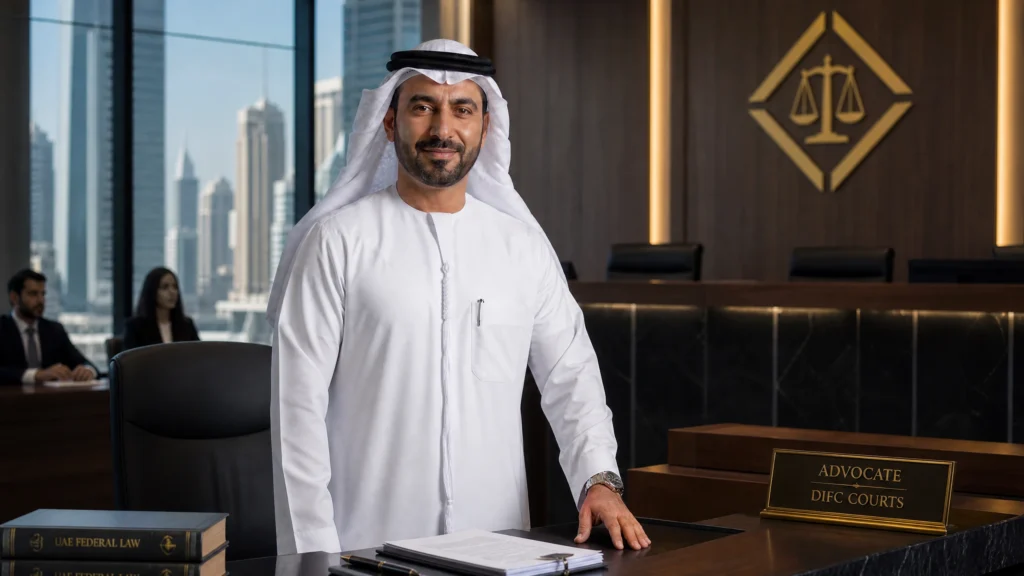
The legal landscape of the United Arab Emirates is a unique and sophisticated “dual-track” system. Navigating this environment requires a deep understanding of the various judicial forums, ranging from local civil law courts to international common law financial centers and specialized arbitration hubs. Under the seasoned leadership of Adv. Ibrahim Khaleel, our firm provides strategic clarity to individuals and corporations seeking to resolve disputes or establish operations across these diverse jurisdictions.
The UAE’s judicial structure is designed to offer flexibility and specialized expertise, ensuring that whether a matter involves local real estate, international finance, or complex maritime logistics, there is a competent forum available. This guide explores the intricate web of UAE Federal and local courts, the autonomy of financial free zones, and the robust arbitration frameworks that define the nation’s legal authority.
The UAE Federal Court System: Sovereignty and Unified Justice
The UAE Federal Courts represent the primary judicial pillar for the Emirates of Sharjah, Ajman, Umm Al Quwain, and Fujairah. While Dubai and Abu Dhabi maintain their own local judicial systems, the Federal Supreme Court remains the highest judicial authority in the land.
The legal framework for these courts is primarily governed by Federal Decree-Law No. 42 of 2022 on the Civil Procedure Law, which modernized court processes and introduced digital litigation. The Federal Courts operate on a three-tier system:
- Court of First Instance: The initial stage for all civil, commercial, and personal status claims.
- Court of Appeal: Allows parties to challenge the factual or legal findings of the lower court.
- Federal Supreme Court: Located in Abu Dhabi, it focuses on the application of the law and constitutional matters.
Recent legislative updates, such as Federal Decree-Law No. 51 of 2023 on Bankruptcy, have further specialized the federal judiciary by establishing dedicated Bankruptcy Courts to manage corporate insolvency with greater efficiency and transparency.
Dubai Courts: A Model of Judicial Efficiency
The Dubai Courts operate independently of the Federal system under the authority of Dubai Law No. 13 of 2016 concerning the Judicial Authority in the Emirate of Dubai. Known for its rapid adoption of technology, Dubai has pioneered the “Smart Court” initiative, allowing for remote filings and virtual hearings.
The jurisdiction of Dubai Courts covers all civil, commercial, criminal, and personal status matters within the Emirate of Dubai, unless the parties have specifically opted for the DIFC Courts. Key specialized circuits within the Dubai Courts include:
- The Rental Dispute Centre (RDC): Governed by Dubai Law No. 26 of 2007, handling landlord-tenant conflicts.
- The Labor Court: Specifically for disputes arising from the Federal Decree-Law No. 33 of 2021 on the Regulation of Labor Relations.
Abu Dhabi Courts: Civil Law Precision
The Abu Dhabi Judicial Department (ADJD) oversees the local court system in the capital. Like Dubai, Abu Dhabi maintains its own independent judiciary while adhering to Federal laws. A significant advancement in Abu Dhabi is the establishment of the Abu Dhabi Civil Family Court, which applies specialized regulations for non-Muslims, reflecting the Emirate’s commitment to a pluralistic legal environment.
Legal matters in Abu Dhabi often intersect with government-related entities and large-scale infrastructure projects. The ADJD provides specialized commercial circuits to handle these high-value disputes, ensuring that the capital’s economic interests are protected by a predictable and authoritative legal process.
DIFC Courts: The Common Law Hub of Dubai
The Dubai International Financial Centre (DIFC) Courts represent a revolutionary shift in the regional legal landscape. Unlike the onshore courts, the DIFC Courts operate under an English-language, common law framework.
Established by Dubai Law No. 9 of 2004 and Dubai Law No. 12 of 2004, the DIFC Courts have jurisdiction over:
- Disputes where the parties are registered within the DIFC.
- Disputes arising from contracts performed within the DIFC.
- “Opt-in” cases where parties from anywhere in the world agree in writing to use the DIFC Courts as their preferred forum.
This “opt-in” capability makes the DIFC an attractive choice for international investors who prefer a common law system for its precedent-based predictability.
ADGM Courts: Direct Application of English Law
The Abu Dhabi Global Market (ADGM) Courts are situated on Al Maryah Island and represent the UAE’s second major common law jurisdiction. While the DIFC has its own codified laws, the ADGM is unique because it directly incorporates English Common Law into its legal framework.
The ADGM Courts are renowned for being “born digital,” utilizing an end-to-end electronic filing system. They serve as a primary forum for financial services, technology startups, and digital asset firms, providing a regulatory environment that is both innovation-friendly and legally rigorous.
Navigating UAE Free Zones: DMCC, JAFZA, DAFZA, and RAKEZ
The UAE’s free zones offer specialized commercial environments, each governed by its own set of administrative regulations while remaining under the overarching criminal and civil laws of the UAE.
Dubai Multi Commodities Centre (DMCC)
The DMCC is a leading hub for global commodities trade. While it utilizes the Dubai Courts (or DIFC, if opted) for litigation, it has its own Disputes Centre for mediation, which often helps parties resolve issues before they reach a formal courtroom.
Jebel Ali Free Zone (JAFZA)
As one of the world’s largest industrial free zones, JAFZA operates under the Jebel Ali Free Zone Authority. Companies here are subject to specific JAFZA rules regarding employment and licensing, though legal disputes are typically adjudicated in the Dubai Courts.
Dubai Airport Freezone (DAFZA)
DAFZA focuses on aviation, logistics, and technology. It provides a highly regulated environment where the DAFZA Authority oversees compliance, ensuring that businesses adhere to international trade standards.
Ras Al Khaimah Economic Zone (RAKEZ)
RAKEZ is a major industrial and business hub in the northern Emirates. It provides a cost-effective environment for manufacturing and trading, with legal matters falling under the jurisdiction of the Ras Al Khaimah Courts, which operate independently within the Emirate of Ras Al Khaimah.
Global Arbitration Forums in the UAE
Arbitration has become the preferred method for resolving complex commercial disputes in the UAE, largely due to the confidentiality and technical expertise it offers. The Federal Law No. 6 of 2018 on Arbitration provides a modern framework aligned with international standards (UNCITRAL).
Dubai International Arbitration Centre (DIAC)
The DIAC is the premier arbitration institution in the region. Following Decree No. 34 of 2021, the DIAC was expanded to incorporate the functions of former centers, making it the default forum for many regional contracts.
International Chambers and Alliances (ICC, LCIA, and SIAC)
- ICC: The International Chamber of Commerce has a strong presence, often collaborating with the ADGM to provide a neutral venue for international parties.
- LCIA: While the DIFC-LCIA was disbanded, the expertise and rules of the London Court of International Arbitration remain highly influential in how contracts are drafted in the region.
- SIAC: The Singapore International Arbitration Centre is frequently cited in UAE-linked contracts involving Asian trade routes, highlighting the UAE’s role as a global crossroads.
The Role of DubaiAdvocates.ae Lawyers and Legal Consultants
Navigating the choice of jurisdiction is a critical strategic decision that can impact the outcome of any legal matter. At DubaiAdvocates.ae, our team, led by Adv. Ibrahim Khaleel, possesses the unique “dual-system” expertise required to represent clients in both the Arabic-speaking Civil Law courts and the English-speaking Common Law courts of the DIFC and ADGM.
We provide comprehensive support in:
- Jurisdictional Strategy: Advising on whether to “opt-in” to the DIFC or ADGM Courts during contract drafting.
- Representation: Acting as authorized counsel before the Dubai Courts, Federal Courts, and specialized arbitration tribunals.
- Enforcement: Assisting in the cross-border enforcement of judgments and arbitral awards between different Emirates and international jurisdictions.
Overview
English:
The UAE offers a diverse judicial system comprising Federal Courts, local Emirate courts (Dubai/Abu Dhabi), and specialized common law financial centers (DIFC/ADGM). Choosing the right jurisdiction is vital for contract enforcement and dispute resolution.
Arabic (العربية):
توفر دولة الإمارات العربية المتحدة نظاماً قضائياً متنوعاً يضم المحاكم الاتحادية، والمحاكم المحلية (دبي/أبوظبي)، والمراكز المالية المتخصصة التي تتبع القانون العام (مركز دبي المالي العالمي/سوق أبوظبي العالمي). إن اختيار الولاية القضائية الصحيحة أمر حيوي لتنفيذ العقود وتسوية المنازعات.
French (Français):
Les Émirats arabes unis offrent un système judiciaire diversifié comprenant des tribunaux fédéraux, des tribunaux locaux et des centres financiers spécialisés en common law (DIFC/ADGM).
Russian (Русский):
ОАЭ предлагают многообразную судебную систему, включающую федеральные суды, местные суды эмиратов и специализированные финансовые центры общего права (DIFC/ADGM).
Chinese (中文):
阿联酋提供多元化的司法体系,包括联邦法院、当地法院(迪拜/阿布扎比)以及专门的普通法金融中心(DIFC/ADGM)。
Frequently Asked Questions
Can I choose the DIFC Courts if my company is in onshore Dubai?
Yes, parties can “opt-in” to DIFC jurisdiction by including a specific clause in their contract.
What is the language of proceedings in Dubai Courts?
The primary language is Arabic, though recent reforms allow for English in certain specialized circuits.
Is an arbitration award enforceable in the UAE?
Yes, under Federal Law No. 6 of 2018, arbitral awards are enforceable through the Courts of Appeal.
Does ADGM follow English law?
Yes, the ADGM directly applies English Common Law.
What happens if a dispute arises in a Free Zone like JAFZA?
Typically, the Dubai Courts have jurisdiction unless a specific arbitration or DIFC clause exists.
Are there specialized courts for family matters for expats?
Yes, the Abu Dhabi Civil Family Court and specific circuits in Dubai handle non-Muslim family matters.
What is the role of the Rental Dispute Centre?
It handles all disputes between landlords and tenants in Dubai.
Can I appeal a DIFC Court decision?
Yes, the DIFC has its own Court of Appeal.
Is a lawyer required for small claims?
While not always mandatory, legal counsel is highly recommended to navigate procedural requirements.
How long does a typical civil case take in Dubai Courts?
With the new digital systems, many cases are resolved within 6 to 12 months.
What is the DIAC?
The Dubai International Arbitration Centre, the region’s leading forum for private dispute resolution.
Can a foreign judgment be enforced in the UAE?
Yes, subject to the conditions of the Civil Procedure Law and international treaties.
Do the Federal Courts apply in Dubai?
Dubai has its own local judicial system, but Federal criminal and commercial laws still apply.
What is the “Born Digital” court?
The ADGM Courts, known for their fully electronic judicial processes.
Who oversees the legal profession in the UAE?
The Ministry of Justice and local departments like the Dubai Legal Affairs Department.
Sum-up
The UAE’s jurisdictional framework is a sophisticated blend of tradition and modernity. From the civil law roots of the Federal and Dubai Courts to the international common law standards of the DIFC and ADGM, the nation provides a robust environment for legal recourse. Understanding where and how to file a claim is the first step toward a successful legal outcome.
Call to Action (CTA):
Email: file@dubaiadvocates.ae Phone/WhatsApp: +971561663345 Website: https://dubaiadvocates.ae/
Disclaimer:
“This content is for general informational purposes only and does not constitute legal advice. For advice specific to your situation, consult a qualified legal professional in the UAE.”
Get in touch
contact us
Send us a email
file@dubaiadvocates.ae
Contact with us
Our office location
Le Solarium Tower, Level 13, Office 13, Dubai Silicon Oasis, Dubai.
A licensed UAE law firm advising individuals and businesses across corporate law, criminal defence, real estate, employment, family law, and commercial disputes — throughout UAE onshore courts, DIFC, and ADGM.
Working hour
- Monday - Friday
- 09:00 am - 07:00 pm